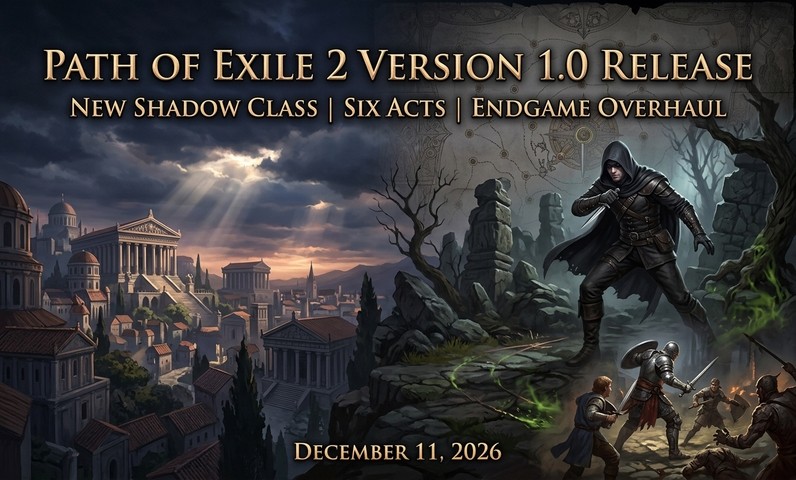
Path of Exile 2 is preparing for one of the biggest milestones in its development with the arrival of Version 1.0 on December 11, 2026. The full release is designed to bring the game out of Early Access and deliver a more complete action RPG experience, featuring additional campaign content, new character options, expanded endgame activities, and extensive gameplay improvements.
Grinding Gear Games (GGG) is using this update to bring together the systems introduced during Early Access while adding substantial new features. From the return to Oriath to the introduction of the Shadow class and a new faction-based challenge league, Version 1.0 is expected to give both returning players and newcomers plenty of reasons to explore Wraeclast again.
Path of Exile 2 Version 1.0 Release Date and Free-to-Play Launch
Path of Exile 2 will officially launch on December 11, 2026, following its extended Early Access period. With the transition to Version 1.0, the game is also scheduled to become free-to-play, opening its world to a much larger audience.
The full release represents more than a simple version update. GGG is bringing together previously separated development features, completing important parts of the campaign, and improving systems that influence character progression and endgame activities.
Players who have followed the game throughout Early Access can expect substantial new content, while newcomers will have access to a more complete experience from the beginning.
The Six-Act Campaign Finally Reaches Completion
One of the most important additions in Version 1.0 is the completion of the main campaign. The full storyline will span six acts, with Acts 5 and 6 introducing new locations, enemies, and challenging boss encounters.
Act 5 returns players to Oriath, a familiar location in the Path of Exile universe. However, the city has been devastated by repeated disasters and is now connected to a dangerous conflict involving the Twilight Order and the Beast. Players must navigate ruined neighborhoods, wealthy estates, temple districts, and other hostile environments while working toward their objectives.
The two new acts introduce 24 additional areas, 18 unique bosses, and more than 20 named rare monsters. These encounters are designed to provide greater variety than standard enemy battles, with some rare monsters featuring distinctive abilities and mechanics that make them feel closer to mini-bosses.
Boss encounters will also feature multiple combat phases and different attack patterns. This should make the campaign more engaging while giving players additional opportunities to test their defensive setups, damage output, and mechanical skills.
Shadow Class Brings Stealth and Trap-Based Combat
The introduction of the Shadow is another major highlight of the full release. This new class specializes in daggers, traps, poison, and stealth-based attacks, offering a different combat experience from the existing character options.
Its defining feature is the Stealth system. While hidden, the Shadow can remain outside enemy detection within a certain range. Attacking from Stealth allows the character to quickly close the distance and perform powerful ambush strikes. Certain abilities also receive additional effects when activated from this state.
The class becomes especially interesting when chaining kills. Defeating an enemy can immediately reset the Stealth cooldown, allowing players to move between targets and maintain an aggressive combat rhythm.
Traps provide another layer of tactical depth. Rather than simply throwing traps at enemies for immediate damage, players can prepare them in advance and lure opponents into carefully arranged combinations. For example, Shrapnel Traps can weaken enemies before Freezing Traps control their movement. Poison-based setups can also create opportunities for explosive follow-up attacks.
The Shadow additionally uses Darkness as a unique resource to increase offensive power. Players can summon a Shade to distract enemies or assist with ambushes. At launch, the class will feature two Ascendancy options: Assassin and Infiltrator.
The Knight Expands the Duelist’s Combat Options
The Knight is another important addition associated with the full release. As a new Duelist Ascendancy, it introduces a commander-style playstyle built around a companion known as the Squire.
Unlike conventional minions, the Squire can be equipped with gear and skill gems, allowing players to customize its combat role. This creates additional possibilities for building a character that combines direct melee combat with companion support.
The Knight can also deploy a War Banner to improve attack speed and damage for both the player and the Squire. Its abilities include Mounted Charge, which lets the character ride into battle using a chariot to knock enemies backward.
These mechanics provide an alternative approach to melee combat, emphasizing battlefield control, companion management, and coordinated attacks.
Conquerors of Wraeclast Introduces a New Challenge League
Version 1.0 will launch alongside the Conquerors of Wraeclast challenge league. This new activity combines mercenary recruitment, army management, tactical battles, and stronghold construction.
Players will rescue captured mercenaries and work with their leader, Varek, to assemble an army. Mercenaries require gold to recruit, while expeditions demand supplies to keep troops prepared for battle.
Combat involves more than sending units into an encounter automatically. Players must consider enemy compositions, position their troops, and select suitable formations. Shield-bearing units, for instance, can protect vulnerable soldiers from incoming arrows when placed along the front line.
The league features more than 70 points of interest throughout the campaign, including 23 standalone battles. Players will encounter village defenses, fortress sieges, and castle assaults, earning gold, supplies, and special crafting materials after successful engagements.
At the endgame stage, players can develop their own strongholds using one of three architectural styles: Ezomyte, Maraketh, or Karui. Each style offers more than 20 buildings and upgrades, creating additional progression opportunities.
A Redesigned Atlas and Expanded Endgame
The endgame is receiving extensive improvements to make progression more streamlined and rewarding. The Atlas passive tree is being reduced to approximately 70 nodes, with individual choices carrying greater influence over the player’s experience.
The update also introduces 25 new endgame maps and simplifies travel between endgame areas. Players will have more opportunities to customize their progression without navigating an unnecessarily complicated passive structure.
One particularly interesting feature is the Commander system. Players can recruit commanders, assign them troops and Waystones, and send them to complete Atlas maps. Up to three commanders can be deployed during endgame progression, allowing players to manage several map expeditions and collect their rewards afterward.
The Conquerors of Wraeclast league also introduces 100 strongholds positioned around the outer Atlas. Controlling these locations provides item rarity bonuses and faction-wide advantages, adding a competitive element to the endgame.
New Unique Items, Passive Tree Changes, and Performance Improvements
Version 1.0 will bring significant changes to equipment and character customization. Approximately 70 existing unique items are receiving improvements to their effects, performance, and visual presentation. More than 40 additional unique items will also be introduced.
The update includes over 200 new base item types, expanding the equipment pool and giving players more opportunities to develop specialized builds.
The passive skill tree is also being reorganized. Around 60 jewel sockets will be distributed throughout individual passive clusters instead of being concentrated along major travel paths. This creates new possibilities for combining passive bonuses and developing different character setups.
Support gems and existing class skills will receive adjustments to improve their interactions with attack and spell characteristics. Ascendancies will also be rebalanced to support the updated systems.
Technical improvements are another important part of the update. GGG has reported substantial CPU performance gains compared with the original Early Access version, alongside reduced memory usage and optimized game data.
What Players Can Expect From Path of Exile 2 Version 1.0
The December 11 launch represents a major step forward for Path of Exile 2. A completed six-act campaign, the Shadow class, the Knight Ascendancy, a new challenge league, and a redesigned Atlas create a much broader experience than the original Early Access release.
Not every originally planned feature will be available immediately. The initial launch is expected to include 10 of the 12 planned classes, while some remaining features and improvements will arrive through subsequent updates. The transfer of purchased microtransactions from the original Path of Exile will also continue after launch.
For players preparing to explore the new campaign, experiment with different builds, or compete in the Conquerors of Wraeclast league, planning equipment and progression resources will be important. Having enough crafting materials and trading currency can make gearing more convenient as new challenges appear. Players looking to prepare their characters and improve their equipment can also explore options to buy POE2 Currency and make their journey through the expanded world of Wraeclast more efficient.